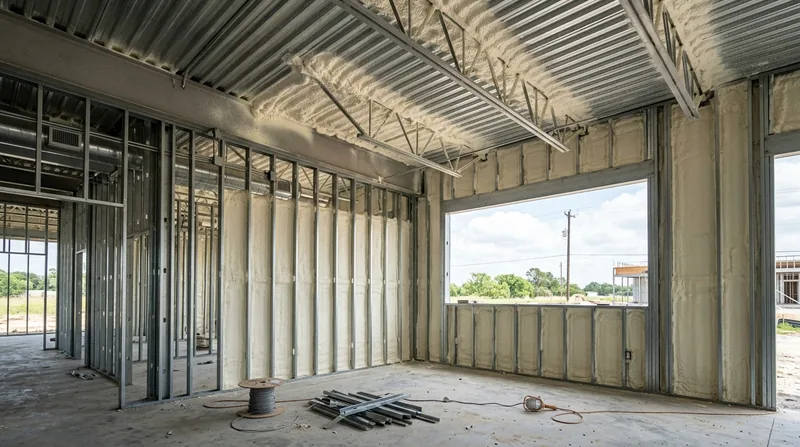




Commercial & New Construction Spray Foam in Beaumont seals building envelopes before drywall goes up, stopping humid air from entering the conditioned space for years to come. Beaumont's climate zone 2A summers are long and hot, and the Golden Triangle's flat terrain along the Neches River means moisture-laden air works inward through walls and attics rather than out. New construction projects across Jefferson and Orange counties face the same challenge: a hot, wet climate where humidity drives cooling costs and threatens comfort if the building envelope is not sealed tight from the start. Whether you are framing a retail shell in Port Arthur, a multi-unit residential project in Nederland, or a light-industrial building in Lumberton, spray foam applied during the rough-in phase reduces the cooling load, cuts infiltration, and protects the structure for decades. We spray foam building envelopes before drywall, drywall panels, and mechanical systems go in, giving you a sealed, energy-efficient base that works with your HVAC strategy, not against it.
Why Commercial & New Construction Spray Foam Matters in Beaumont's Hot, Humid Climate
Beaumont's summers run nine months or longer, and the air-conditioning season drives energy costs higher than the national average. Standard fiberglass batts and blown-in cellulose leave thermal gaps around ductwork, electrical penetrations, and rim joists where humid air leaks in. Spray foam seals the entire envelope in a single pass, eliminating those leakage paths before occupancy. New construction is the ideal time to make this investment because the cost of spray foam at rough-in is far lower than retrofitting after drywall and finishes are in place. A sealed attic or roof deck also means you can run ductwork and mechanical equipment in conditioned space, reducing the load on your HVAC system and lowering utility bills from year one.
- We eliminate air infiltration through rim joists, band joists, and band board transitions before the slab or rim is covered.
- We seal around all ductwork, electrical, and plumbing penetrations so humid air cannot bypass your insulation.
- We spray roof decks and attics before drywall to create an unbroken thermal and air barrier.
- We control moisture and condensation on metal roof decks and building shells where steel sweats in Beaumont's humidity.
- We can spray open cell or closed cell depending on your use, ventilation strategy, and moisture profile.
Sealing the envelope during new construction is the single most cost-effective phase to apply spray foam, because labor and material costs are lowest when the building is still open.
Key info: New construction projects in Beaumont, Port Arthur, Orange, and Liberty counties benefit from spray foam applied at rough-in. A sealed attic or roof deck reduces the cooling load by 15 to 30 percent compared to standard fiberglass, depending on air sealing thoroughness and foam type. We work with builders and general contractors to spray before drywall, inspections, and mechanical rough-in.
For more information on how spray foam is applied in different building types, see our guide to closed cell spray foam insulation, which is the standard choice for controlling condensation in sealed commercial envelopes.
How We Spray Commercial & New Construction Envelopes in Beaumont
Commercial and new construction spray foam requires coordination with the general contractor, the building schedule, and the local building department. We arrive at rough-in, after framing but before drywall, and spray the roof deck, attic, walls, rim joists, and any other cavities that need sealing. The process is fast, non-invasive, and does not interfere with other trades. We use mechanical ventilation during application and cure, and we specify a re-entry window that your GC and HVAC contractor can plan around. Closed cell foam is the standard for sealed envelopes and metal buildings because it provides moisture control and structural benefit on steel. Open cell is sometimes used in vented attics or where cost is the primary driver, though in Beaumont's humid climate closed cell is the more durable choice.
- We meet with your general contractor and building team to schedule spray at the right phase of construction.
- We inspect the substrate, identify any moisture, and walk away if the building is not dry enough to spray.
- We spray to the specified R-value and thickness, documented in writing with board-foot totals.
- We set up mechanical ventilation during cure and provide a written re-entry window, typically 24 to 48 hours.
- We coordinate with your local building department on any inspections or thermal barrier requirements that apply to your project.
- We remain available after the job for questions about performance, re-entry, or next-step coordination with your HVAC contractor.
The result is a sealed, insulated envelope that is ready for drywall, mechanical rough-in, and final construction phases without delay.
Example: A two-story retail building in Groves with a sealed attic and unvented roof deck requires spray foam on the roof deck underside, the rim joist, and all wall cavities where ductwork or plumbing runs. We coordinate with the GC to spray after framing inspection, before drywall delivery. The job is completed in one to two days, and the building is re-entered after the cure window closes.
Learn more about how spray foam integrates with your building envelope by reviewing our air sealing service, which covers all penetrations and transitions.
Spray Foam Methods for Commercial & New Construction in Beaumont
| Method | Description | Best For |
|---|---|---|
| Closed Cell Spray Foam | Two-part polyurethane sprayed at high pressure, cures rigid and dense, R-value 6.0 to 6.5 per inch, provides air seal and vapor barrier. | Metal buildings, sealed attics, roof decks, humid climates, structural support, moisture control. |
| Open Cell Spray Foam | Two-part polyurethane sprayed at lower pressure, cures soft and flexible, R-value 3.5 to 3.8 per inch, breathes to allow drying. | Vented attics, sound dampening, interior walls where vapor permeability is desired, cost-conscious projects. |
| Rim & Band Joist Spray Foam | Closed cell applied to the rim joist, band board, and sill plate to seal the transition between foundation and framing. | All new construction, crawl space sealing, basement insulation, eliminating thermal bridging at foundation. |
| Wall Cavity Spray Foam | Closed or open cell applied directly into wall cavities before drywall, filling voids and sealing around electrical and plumbing. | New construction walls, exterior perimeter walls, interior walls with ductwork or plumbing, high-performance buildings. |
Commercial & New Construction Spray Foam Cost in Beaumont: What to Expect
The cost of spray foam for new construction varies based on the size of the project, the R-value required by code, the building geometry, and access for our equipment. A free commercial estimate is the starting point, and it includes a walkthrough, a measurement of the spray area, a review of your building plans or specifications, and a written quote with board-foot totals, R-value, and thickness. Most new construction projects in Beaumont and the Golden Triangle run from a few thousand dollars for a small retail shell to $15,000 to $40,000 or more for a multi-story residential or commercial building. The factors that move cost are the total square footage to be sprayed, the foam type (closed cell is higher than open cell), the thickness required by code, and whether the project includes sealed attics, rim joists, walls, or all three.
We provide detailed pricing guidance for common project types, and every estimate is written with R-value and thickness so you can compare apples to apples with other contractors. Getting two or three estimates from local spray foam companies is smart practice because pricing and method can differ significantly, and you want to understand what you are paying for. Always ask any contractor for their insurance certificate, their approach to ventilation during cure, and their warranty on workmanship. Do not choose based on price alone: the cheapest estimate often reflects shortcuts in material ratio, drum temperature, pass thickness, or ventilation that show up as odor, off-gassing, or poor performance months after the job is done.
For detailed pricing on common new construction scenarios, visit our pricing page. Call us at (409) 351-3691 for a free estimate on your project.
What to Look for When Hiring a Commercial & New Construction Spray Foam Contractor Near Beaumont
Choosing a spray foam contractor for new construction is a decision that affects your building's performance and your relationship with your general contractor. The best contractor is the one who shows up on schedule, communicates clearly with your GC and building team, provides written estimates with R-value and thickness, and stands behind the work with a clear warranty and insurance. In Texas, contractor registration and licensing requirements are set by the city or county where the work is performed, not by the state. Before hiring any contractor, including us, ask them to confirm the registration and insurance their local building department requires and to provide a current insurance certificate. Do not hire a contractor who cannot produce proof of insurance or who promises a price far below the market rate, because those are the markers of cut-rate work and crews that disappear when problems arise.
- Verify that the contractor carries liability and workers compensation insurance and can provide a current certificate on request.
- Ask for references from recent commercial or new construction projects and check at least two.
- Request a written estimate that includes R-value, thickness, board-foot totals, and the foam type (closed cell or open cell).
- Confirm that the contractor will use mechanical ventilation during application and cure and will provide a written re-entry window.
- Ask whether the contractor coordinates with your local building department on inspections and permits, and whether they are familiar with the building code in force at your address.
- Understand the contractor's workmanship warranty and what it covers (typically one to three years on the installation, not including manufacturer system warranties).
A local contractor with a local address and a reputation in Beaumont and the Golden Triangle is your best choice, because they are reachable if questions arise after the job is done and they understand the regional climate and building practices.
Ready to discuss your project? Contact us for a free commercial estimate, or call (409) 351-3691 to speak with a spray foam specialist about your new construction timeline and requirements.
Commercial & New Construction Spray Foam in Beaumont: Pricing Guide
| Service | Price | Details |
|---|---|---|
| Free commercial estimate | Free | Includes site walkthrough, plan review, board-foot measurement, R-value and thickness specification, written quote with no obligation |
| Closed cell spray foam | Starting at $1.50-$2.25 per board foot | Price varies by thickness, R-value requirement, building size, and access. Sealed attics, roof decks, rim joists, walls, metal buildings |
| Open cell spray foam | Starting at $0.90-$1.40 per board foot | Lower cost option for vented attics and interior walls where vapor permeability is acceptable. Suitable for cost-conscious new construction |
| Multi-story or complex commercial project | On estimate | Large buildings, sealed envelopes, multiple zones, integrated HVAC require on-site inspection and coordination with GC and building plans |
| Travel and coordination | Included | No mileage fee or travel charge in Beaumont, Port Arthur, Nederland, Lumberton, Orange, and surrounding service areas |
Indicative pricing, the exact cost depends on square footage, finish, and site access. Free personalized estimate within 24h at (409) 351-3691.


