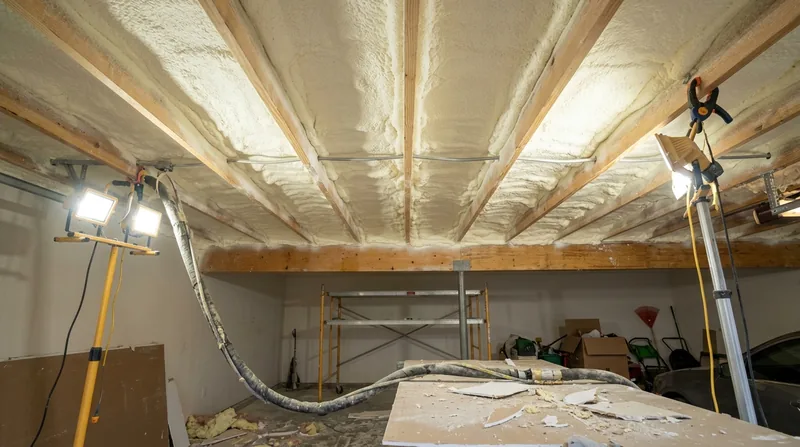




Garage spray foam insulation in Beaumont tackles a specific problem in newer west end and Lumberton-area subdivisions: rooms built over unconditioned garages that bake in summer heat and bleed cool air downward through the floor assembly. When an upstairs bedroom or home office sits directly above a garage, the temperature difference between conditioned and unconditioned space drives heat transfer year-round, pushing cooling costs higher and making upper rooms uncomfortable. Beaumont's long, hot cooling season compounds the issue, especially in two-story plans where HVAC ducts run through vented attics above the garage and the hot air finds every seam. We foam the garage ceiling and walls to break that thermal bridge, cut the heat load on your air conditioning system, and stabilize indoor temperatures without the noise and inefficiency of a separate mini-split or extension ductwork. This is one of the highest-return insulation upgrades for Beaumont homeowners building new or retrofitting existing homes.
Why Garage Spray Foam Insulation Matters in Beaumont's Climate and Housing Stock
Beaumont's residential neighborhoods split into two thermal worlds: older pier-and-beam homes with vented attics pulling in humid Gulf air, and newer slab-on-grade subdivisions with two-story plans where upper rooms depend entirely on first-floor conditioning. In the west end and toward Lumberton, newer construction often places bedrooms, home offices, or bonus rooms directly over an attached but unconditioned garage. That garage stays at outdoor temperature year-round, radiating heat upward through the ceiling drywall in summer and pulling conditioned air down through gaps in the floor assembly. Standard fiberglass batts in the joist cavities offer little resistance to this thermal short circuit because air moves around them, and vented attic space above the garage lets hot air pool and press downward. Spray foam seals the entire assembly, eliminates air movement, and maintains a continuous thermal and air barrier.
- Stop heat transfer from an unconditioned garage into bedrooms and living space above, cutting cooling load during Beaumont's eight-month cooling season.
- Seal air leaks around rim joists, band boards, and ductwork penetrations that fiberglass batts cannot reach or cover.
- Prevent warm, humid outdoor air from infiltrating the floor cavity through gaps in the rim assembly, which is a common failure point in newer construction.
- Improve comfort in upper rooms by stabilizing temperature and reducing the cold draft sensation that occurs when AC struggles against heat coming up from below.
- Lower HVAC runtime by reducing the cooling load in rooms above garages, which translates to lower utility bills and less wear on your system.
Spray foam insulation is the only product that addresses all three failure modes at once: thermal resistance, air sealing, and moisture control in a humid climate.
Key info: A typical two-story Beaumont home with a bedroom over the garage sees indoor temperatures 3 to 5 degrees Fahrenheit higher in that room on a 95-degree summer day when the garage is foam-insulated versus fiberglass-batted. That gap widens in homes where the garage door faces west or where the attic above is vented to outdoor temperature.
For more context on how air sealing and thermal barriers work together in Beaumont's climate, see our air sealing service page.
How We Insulate and Seal a Garage in Beaumont: The Process from Start to Finish
Garage spray foam insulation begins with a walk-through to identify the thermal boundary, air leak points, and the type of foam that best suits the job. In Beaumont, most garage ceiling jobs use closed cell spray foam because it delivers higher R-value per inch, resists moisture in our humid climate, and provides structural support to the rim joist assembly. We measure the garage ceiling and walls, confirm the thickness required to meet code in your city, and plan the spray sequence to avoid re-entry delays. Once you approve the estimate, we schedule the work, set up temporary ventilation, and spray the foam in controlled passes to achieve the specified thickness and density. After the foam cures, we inspect for coverage, confirm the R-value visually and by thickness measurement, and provide a written record of what was applied.
- We walk through the garage ceiling and walls to locate thermal bridges, air leaks around rim joists, and any existing insulation that needs removal.
- We measure and calculate the board-foot volume needed to reach the R-value and thickness specified in your written estimate.
- We set up mechanical ventilation in the garage during the spray and cure period to manage VOCs and ensure proper off-gassing.
- We spray the foam in multiple thin passes rather than one thick pass, which ensures even density and prevents over-application or voids.
- We allow the foam to cure per manufacturer specifications (typically 24 to 48 hours) before the garage is re-entered or drywall is installed over the foam.
- We provide a written summary of the R-value, thickness, and board-foot volume applied, which becomes part of your home's insulation record.
This methodical approach prevents the common mistakes that plague DIY or rushed installations: uneven coverage, incorrect ratio, insufficient curing time, and missing air seals around penetrations.
Example: A 400-square-foot garage ceiling in Lumberton with 16-inch joist spacing and 6 inches of closed cell foam delivers R-36 thermal resistance and complete air sealing of the rim board, ductwork penetrations, and electrical chaseways. The cure window is 48 hours, after which drywall can be hung without odor or off-gassing concerns.
Garage Spray Foam Insulation Methods and Approaches
| Approach | Description | Best for |
|---|---|---|
| Closed Cell Spray Foam, Garage Ceiling | High-density foam sprayed 4 to 8 inches thick into joist cavities and over rim boards. R-value 6 to 6.5 per inch. Provides structural stiffness and vapor resistance. | Rooms directly above garages, humid climates, assemblies requiring air sealing plus high R-value in limited space. |
| Closed Cell Spray Foam, Garage Walls | Foam applied to interior or exterior garage walls from floor to ceiling. Seals rim joist, band board, and wall cavity air leaks in one pass. | Finished or semi-finished garages, wall cavities with air infiltration, homes where the garage wall is adjacent to conditioned space. |
| Open Cell Spray Foam, Garage Ceiling | Lower-density foam, R-value 3.5 to 3.7 per inch. Softer, easier to cut and trim. Allows vapor diffusion. Lower cost per square foot. | Budget-conscious retrofits, garages in dry climates or where vapor permeability is acceptable, top-up jobs on existing insulation. |
| Spray Foam Plus Drywall or Rigid Cap | Foam is sprayed, then drywall or rigid foam board is fastened over it to provide the required thermal barrier and fire rating per code. | All garage applications. Thermal barrier and ignition barrier are separate products; foam alone does not meet code exposure requirements. |
Beaumont's building code and your city's specific requirements determine whether a 15-minute thermal barrier (drywall) or other covering is required. We confirm what applies at your address and price the complete assembly, never the foam alone.
Garage Spray Foam Insulation Cost in Beaumont: What to Expect
Garage spray foam insulation in Beaumont starts at $1,200 for a small garage ceiling (under 300 square feet) with 4 to 6 inches of closed cell foam, and rises to $2,500 to $4,000 for a full two-car garage with walls, rim joist sealing, and ductwork penetration work. The cost depends on four main factors: the square footage of ceiling and walls being foamed, the thickness and R-value required by your code, the type of foam (closed cell costs more but delivers higher R-value per inch), and whether existing insulation must be removed first. A bedroom over a garage in Lumberton with fiberglass batts already in place will cost less to foam than a garage with no insulation, because the crew does not have to remove and dispose of old material. If the garage has active air leaks around the rim board or ductwork, or if the attic above is vented and pulling in hot air, the foam thickness may need to increase to offset the heat load, which raises the price. Getting two or three written estimates from local contractors is the best way to understand what your specific garage requires and why prices differ.
For a detailed breakdown of pricing across different job sizes and scopes, see our full pricing page. We provide written estimates with R-value and thickness specifications, so you know exactly what you are paying for before work begins.
What to Look for When Hiring a Garage Spray Foam Insulation Contractor Near Me in Beaumont
Finding a qualified spray foam contractor near Beaumont requires the same diligence you would apply to any home improvement hire. Verify that the contractor is fully insured and can provide a certificate of insurance covering general liability and workers compensation. Ask for written estimates that include the R-value, thickness in inches, and total board-foot volume being applied, not just a lump-sum price. Confirm that the contractor will provide mechanical ventilation during the spray and cure phases, which is the mark of a professional installation and prevents the odor complaints that plague rushed or poorly ventilated jobs. Check references from recent jobs in Beaumont or nearby towns like Port Arthur, Nederland, or Groves, and ask specifically about odor management, cleanup, and whether the installer was responsive if questions arose after the work. Understand what your city requires in terms of contractor registration or permits before spray foam work begins, and ask the contractor to confirm they hold any registration your municipality requires. If your garage is in an HOA community, check whether architectural review is needed for any visible changes, though most HOA rules do not govern interior insulation work. Most importantly, be wary of any estimate with no R-value or thickness specified, a price far below market, or a promise of immediate re-entry; those are warning signs of an installer who cuts corners or does not understand the product. Contact us for a free estimate Your local building department can tell you what applies at your address.
For additional guidance on evaluating any insulation contractor, consult the Consumer Reports guide to hiring contractors, which covers licensing, insurance verification, and reference checking in detail.
Garage Spray Foam Insulation in Beaumont: Pricing Guide
| Service | Price | Details |
|---|---|---|
| Small garage ceiling (under 300 sq ft) | Starting at $1,200 | 4 to 6 inches closed cell foam, R-24 to R-36, includes rim joist sealing and air leak work |
| Full two-car garage (ceiling and walls) | $2,500 to $4,000 | Complete thermal and air barrier, closed cell foam, ductwork and penetration sealing, drywall thermal barrier prep |
| Garage with insulation removal | Add $300 to $600 | Removal and disposal of existing fiberglass batts, blown-in insulation, or debris before foam application |
| Ductwork and rim joist air sealing (add-on) | $400 to $800 | Targeted foam application to seal HVAC ducts, band boards, and thermal bridges in existing garages |
| Travel and estimate | Included and Free | No separate mileage charge in Beaumont and surrounding Golden Triangle areas, free written estimate within 24 hours |
Indicative pricing, the exact cost depends on square footage, finish, and site access. Free personalized estimate within 24h at (409) 351-3691.


